Estimated reading time: 5 minutes
You’ve heard of meditation, but you’re not quite sure what it means to meditate? You’re not alone.
The Sanskrit word for meditation is Dhyāna (ध्यान). This word actually has no direct translation in English (we use “meditation”), but if you look it up in a dictionary, “to meditate” comes up as “to consider, to reflect on, to contemplate” [i]
And that’s not quite what Dhyāna is.
Meditating isn’t about stopping your thoughts, or emptying your mind. It’s about placing yourself in the position of the observer, and letting go of your identification with your thoughts, of “being” your thoughts.
What Dhyāna Really Means
When we reach the state of Dhyāna, we’re able to transcend the layers of our various bodies (physical, energetic, mental, intellectual). Transcending the mental body doesn’t mean you stop thinking. It means you stop identifying with what you think, observing your thoughts instead of being them. To meditate, we work toward settling all these bodies, like a still pool of water, undisturbed.
According to Patañjali, in his Yoga Sūtra, the definition of Yoga (which has Dhyāna as its main gateway to Samādhi, supreme consciousness) is this:
Yogaḥ citta vṛtti nirodhaḥ (योगः चित्त वृत्ति निरोधः)
Yoga is the cessation of our identification with the contents of the psyche.
- Citta (चित्त, pronounced “chitta”) is consciousness, made up of three factors: mind (manas), intellect (buddhi), and ego (ahaṃkāra).
- Vṛtti (वृत्ति) can be translated as state of mind, fluctuations of the mind, mode of action, movement.
- Nirodhaḥ (निरोधः) means obstruction, cessation, control. [ii]
If you’re thinking “but I can’t stop thinking!”, relax: that’s not what’s being asked of you. Our mind exists to always be creating, always producing thoughts, and it isn’t used to being still. In India, they say the mind is more restless than a drunk monkey, with its fur on fire and stung by a scorpion (imagine the chaos going on in our minds).
What we’re training isn’t the absence of thought. It’s the ability to step back from it, to observe it without losing ourselves in it. And that training takes time, just as training the physical body or the breath does.
The Eight Limbs of Yoga According to Patañjali
According to Patañjali, the path to meditation (and to Samādhi) unfolds through eight limbs of Yoga, defined in the Yoga Sūtra:
- Yama (ethical restraints)
- Niyama (spiritual observances)
- Āsana (posture, the practice of the asanas)
- Prāṇāyāma (expansion of vital energy through breath control)
- Pratyāhāra (withdrawal of the senses)
- Dhāraṇā (concentration)
- Dhyāna (meditation)
- Samādhi (complete absorption) [iii]
The last three limbs come together in what’s called Samyama, and it’s there that meditation truly happens.
How to Start Meditating
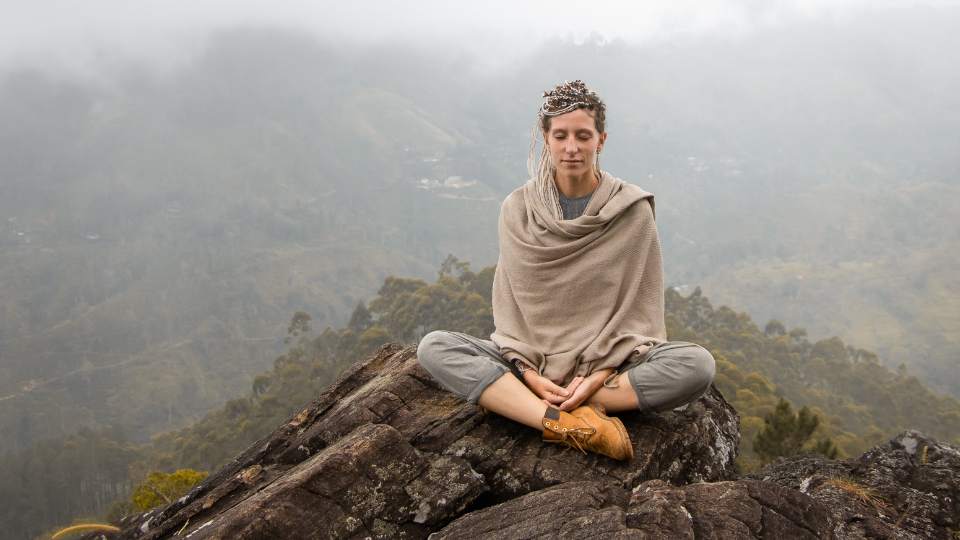
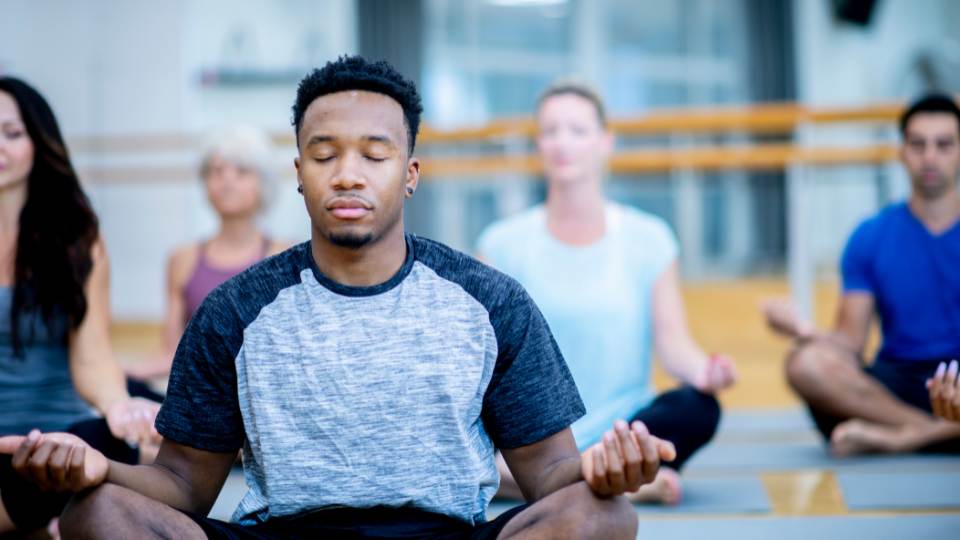
To meditate, you’ll first need to learn to settle the physical body: finding a seated position that’s comfortable for you, one where your body doesn’t get in the way. That’s why the practice of āsanas matters so much, it helps you gain flexibility, strength, and learn to relax the physical body.
You’ll also need to settle the physiological body through your breath. Prāṇāyāma training is a powerful ally in this process.
For the psychological, or mental, body, one technique you can use is simply observing your thoughts, as if they were being projected on a screen in front of you. Or picture yourself sitting on a riverbank, with your thoughts flowing by like water: you see them pass, but you don’t chase after them, you just observe, without identifying with them. Once you’ve built some practice with this technique, you can start choosing an object of concentration, a point of focus.
As you gradually settle the denser bodies, you move closer to the subtler ones (the body of supreme joy, Ānanda, and your true Self, the Ātman), moving toward Samādhi, supreme consciousness.
A Path, Not a Destination
This is a path that takes years, not days, weeks, or even months. It takes dedication, commitment, effort. That’s exactly why it’s so easy to give up.
But every time you sit down to meditate, you’re a little closer to getting there. Some days your mind won’t stop racing, some days you can’t help but hear your own breath, and some days you’ll feel like you’ve gone further. All of these days matter on your path toward meditation.
Your Yoga practice will help you get there faster, and further. To start, simply set aside two minutes a day to sit and just be there, observing (your physical body, your breath, your thoughts or emotions, whatever comes up). Create that time, that space, just to be. Over time, you’ll find yourself wanting to stay longer, and you’ll notice that meditating right after a Yoga class brings far more results than meditating out of nowhere, in the middle of the day.
Whatever path you choose, or method you decide to use, don’t wait for this or that to happen first. Open yourself to the experience, accept whatever comes (or doesn’t come), and simply embark on the journey.
[i] Online Priberam dictionary – https://dicionario.priberam.org/meditar
[ii] B. K. S. Iyengar 1993 – Light on the Yoga Sūtras of Patãnjali – Thorsons
[iii] B. K. S. Iyengar 1993 – Light on the Yoga Sūtras of Patãnjali – Thorsons pp xi (Tradução livre)
Ready to begin this journey?
Tell me in the comments what’s been holding you back from starting.