

Estimated reading time: 4 minutes
Learning to manage and deal with our emotions is essential for personal growth. But how does self-knowledge actually support that? That’s what this article is about.
We Are Far More Than a Physical Body
Did you know you’re made up of several bodies? Like an onion, a human being has layers — in Sanskrit we call them Kosha, meaning veil or sheath. These layers conceal our true self, our real essence. Some are denser, made of matter. Others grow increasingly subtle, made of vibration, energy, consciousness.
The Five Bodies — the Pañca Kośa (it reads pantcha kosha)
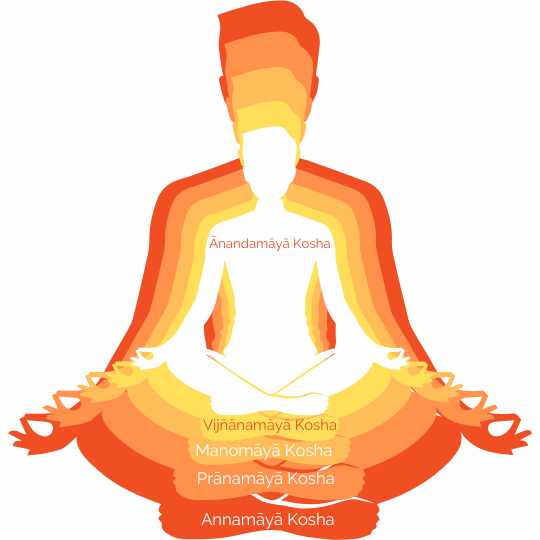
Annamāyā Kośa — the physical body
The body you can see, touch, and feel. It’s the densest, made of matter — the same matter stars are made of. This body handles our basic survival needs: food, water, shelter. Anna means food; māyā means that which makes the unreal seem real (illusion).; Kośa means body or layer.
Prāṇamāyā Kośa — the energetic body
More subtle than the physical body, you may have already felt it without realizing what it was. This energy can show up as warmth, as vibration, as presence. This body plays a key role in our vital functions — digestion, circulation, breathing. Prāṇa means vital energy.
Manomāyā Kośa — the mental and emotional body
This is the body of feelings, thoughts, emotions, memory, and imagination. Some traditions treat the emotional body as separate from the mental one — but whether they’re one or two, they’re deeply intertwined. Mano means mind.
Vijñānamāyā Kośa — the intellectual body
Made up of intellect, intuition, and inner wisdom. It’s one of the subtler bodies — we often go years without even noticing it exists. We recognize our intuition, but how often do we let the mind take over instead of following that instinct? Vijñāna means knowledge or wisdom.
Ānandamāyā Kośa — the body of supreme joy
The last veil covering our true Self — the Ātman. This body is responsible for joy, happiness, love, and it’s through this body that we can experience our interconnection with all things. Ānanda means supreme happiness.
What Does This Have to Do With Your Emotions?
Your emotions live mainly in the Manomāyā Kośa — the mental and emotional body. But as you can see, that body doesn’t exist in isolation. It’s connected to the physical body, the energetic body, the intellectual body. When an emotion arises, it echoes through every layer.
That’s why emotional intelligence can only be built through self-knowledge — in Sanskrit, Svādhyāya. And self-knowledge begins with something very simple: pausing and observing.
Observing your physical body. Your breath. Your emotions. Your mind. That pure observation, free of preconceptions and judgment, is the doorway into emotional management work.
Emotions Have a Cycle — and They Need to Complete It
Here’s something that can help you stop suppressing what you feel: emotions have a natural cycle, just like everything in nature. They arrive, they show themselves, and they move on — if we let them.
The trouble is that we were raised (and helped raise each other) in a society that undervalues emotional intelligence and confuses managing emotions with pretending they don’t exist. When we suppress what we feel, the emotion doesn’t vanish — it stays. And sometimes it stays so long that it wears us down.
My favorite way to picture it: our natural state is the sun — the joy, the love, the happiness of the Ānandamāyā Kosha. Other emotions are clouds passing by, occasionally covering the sun. But the sun is always there, even when we can’t see it.
There are no good or bad emotions. They’re all valid. They all tell us something about ourselves.
How to Work With Your Emotions in Practice
Allow yourself to express what you feel — without suppressing it, and without putting your own integrity or anyone else’s at risk. If you need to cry, cry. If you need to move, move. Let your emotions complete their cycle, and gradually you’ll learn to settle your emotional body.
In Yoga practice, each technique works on a different layer:
- Āsana practice settles the physical body
- Prāṇāyāma settles the energetic body
- Self-knowledge (Svādhyāya) settles the emotional body
- Meditation (Dhyāna) settles the mental body
This work can (and should) also be supported by psychotherapy — the two practices complement each other beautifully.
Self-knowledge is a path, not a destination. And every time you pause to observe yourself — on the mat or off it — you’re taking a step along that path.
Had you thought about this before?
Tell us in the comments how you usually deal with your emotions.